18th Century Buttons and Early 19th Century ButtonsA great variety of buttons were used mainly on men's clothing during the 18th and early 19th centuries. Generally thread and fabric covered buttons were most common on civilian clothing and metal buttons were used on military clothing but button molds (used for making thread and fabric covered buttons) have been found at all military archilogical digs in some cases in great numbers. Some extant garments have metal buttons covered with fabric. The least common of the buttons were horn which were made in small numbers in England and exported. Thread & Covered Buttons | Horn Buttons | Metal Buttons | Other Closures |
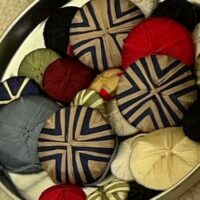
Thread ButtonsThread buttons were used on men's shirts and other undergarments from the late 17th into the early 19th century. Not only were thread buttons less expensive than bone, wood or metal but they would not break during the strenuous beating and scrubbing used by the laundresses which is described in the book The Laundress. Unlike buttons made of other materials, thread buttons are soft and comfortable to lay against while sleeping. Thread buttons (also called Dorset buttons after the area that produced many) are individually hand made from either unbleached (top), off white (center) or white (bottom) strong 16/2 linen thread and are approximately 1/2" in size. There is a small thread shaft at the back to sew to your undergarment (right). In 1757 a criminal trial was recorded in The Proceedings of the Old Bailey, London in which a man "was indicted for stealing . . . twelve dozen of thread buttons for shirts" among other things. You can learn to make your own thread buttons like these with The Lady's Guide to Plain Sewing [Book I]. |
![]() |
|
$1.50 - Unbleached |
|
Star Type 1 ButtonsThroughout the 18th and early 19th centuries there were many types of thread buttons available. Star buttons were less common than death head or basket but are found on some original garments. Our 5/8 inch (14 mm) buttons are a perfect size for a man's waistcoat and are made of silk over a pasteboard button mold. In The Proceedings of the Old Bailey, London in 1789 a criminal was identified when the accuser said "This is the coat I saw the prisoner with; I am looking at the stars on the buttons, it was a new coat and very pretty buttons". Add Black 5/8 Inch Star Type 1 Button to Cart |
![]() |
|
$3.00 each |
|
Star Type 2 ButtonsThroughout the 18th and early 19th centuries there were many types of thread buttons available. Star buttons were less common than death head or basket but are found on some original garments. Our 5/8 inch (14 mm) buttons are a perfect size for a man's waistcoat and are made of silk over a pasteboard button mold. In The Proceedings of the Old Bailey, London in 1789 a criminal was identified when the accuser said "This is the coat I saw the prisoner with; I am looking at the stars on the buttons, it was a new coat and very pretty buttons". Add Black 5/8 Inch Star Type 2 Button to Cart |
![]() |
|
$3.00 each |
|
Basket ButtonsBasket buttons were a popular 18th century style of thread or "Dorset" button. Our 5/8 inch (14 mm) buttons are a perfect size for a man's waistcoat and are made of silk over a pasteboard button mold. In The Virginia Gazette of 1771, "RAN away . . . an English indented servant man . . . and is a button maker by trade . . . He had on and took with him a suit of mixed grey broad cloth, trimmed with basket buttons". Add Black 5/8 Inch Basket Button to Cart |
![]() |
|
$3.00 each |
|
5/8 Inch Death Head ButtonsDeath head buttons were used on men's coats and waistcoats throughout the 18th and into the early 19th century. They were used on everyday business attire not for best dress. These death head buttons are a good size for waistcoats and hand made on a pasteboard blank of silk thread. In The Proceedings of the Old Bailey of 1785, it is recorded "Prosecutor. I described every mark before I saw them at Mr. Moffat's, I ordered horn buttons put to the waistband, and the flap, and the pockets, and death-head buttons to be put to the knees" of the breeches. Add Black 5/8 Inch Death Head Button to Cart |
![]() |
|
$3.00 each |
|
One Inch Death Head ButtonsDeath head buttons were used on men's coats and waistcoats throughout the 18th and into the early 19th century. They were used on everyday business attire not for best dress. These death head buttons are a good size for a coat and hand made on a bone blank of silk thread. Since these are hand made there is a limited supply. |
![]() |
$4.00 - each |
|
Dorset Thread ButtonsDorset buttons originated in southern England where their name is derived. Throughout Dorset, thread buttons became a cottage industry beginning in the early 18th century and continuing to the third quarter of the 19th century. Families, prison inmates and orphans were employed in the manufacture of thousands each year which were used throughout the UK and exported all over the world. These 1/2" (1.3 cm) machine made thread buttons are made of cotton over metal rings to which you may add a thread shank to attach them. They hold up well in the wash, and may be dyed. These may give your waistcoat that special touch but they may also be added to shirts. In the image the lower left button is showing the back side. |
![]() |
$1.50 each |
|
Set of Ten Brass RingsBrass rings are for making fabric covered and thread cartwheel buttons (we suggest white or half bleached linen 35/2 thread). Instructions are found in The Lady's Guide to Plain Sewing [Book II]. for making both types of buttons. These solid brass rings have a 1/2" (12 mm) diameter which is a good size for waistcoat buttons for the 18th and early 19th centuries. |
![]() |
$1.50 - set of ten |
|
Wooden Button MoldsButton molds were used to make both cloth and thread (passementerie) covered buttons such as this example held at the Deerfield Museum. The drill bits used to make these had a guide in the center which left a hole. The center hole is necessary when making "death head" and "basket weave" thread covered buttons. Directions to make "death head" buttons are in "Death Head" buttons their use and construction. In The Virginia Gazette in 1774, "RUN away . . . a Scotchman . . . He had on . . . a Newmarket coat of light bath coating, not bound, but stitched on the edges, with death head buttons on it". |
![]() |
|
70¢ each - 1 1/4" Wood |
|
Domed Bone Button MoldsBone button molds are slightly domed on one side and flat on the other as were common in the mid to late 18th century. It is easiest to make "death head" buttons using wood button molds since the rough texture of the wood help hold the threads in place. Fabric covered buttons may be made of either but if the garment will be washed bone may hold up better. Directions for cloth covered buttons are included in The Lady's Guide to Plain Sewing [Book II] and The Packet V. For example in New Jersey in 1780, there was "Stolen from a House - one light coloured watch-coat, buttons covered with the same coloured cloth". |
![]() |
70¢ each - 1" Domed Bone |
|
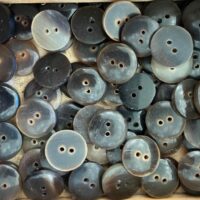
Horn ButtonsHorn buttons, only 1/8" thick, work well for spatterdashes and gaitered trousers but were sometimes used in other outer clothing. These strong durable buttons were competitive in price with other types but available in limited numbers in the 18th century since the making of them was slow. Being stamped or pressed out of horn these lack the center hole of the wood and bone molds. Rather these have two small holes. For example advertised in The Virginia Gazette of 1776, "RUN away . . . in Frederick county, Maryland . . . two Irish servant men, both weavers, [one of them] . . . had on a short pale blue coat, that has been turned, double-breasted, with black horn buttons". |
![]() |
|
70¢ each - 5/8" |
|
18th Century Pewter Buttons Set with White StonesThere are many examples of 18th century buttons set with both cheap and expensive stones. Since these 7/8 inch (just over 2 cm) buttons are white they will go with any color coat or jacket. Resembling cut opals, the stones are mounted securely onto the highest quality pewter button. On page 56 of Cloth and Costume there is pictured one button set with a blue and another button set with a clear stone. In The Proceedings of the Old Bailey in London, four criminals "were indicted for that they, together . . . king's highway, on Ann White, widow, did make an assault, putting her in corporal fear, and danger of her life . . . 4 pair of silver buttons set with stones, and other things, the goods of the said Ann did steal, take and carry away." These buttons are copied from originals found on an early 18th century Spanish ship. |
![]() |
|
$2.50 each |
|
18th Century Pewter Buttons Set with StonesThere are many examples of 18th century buttons set with stones. On page 56 of Cloth and Costume there is pictured one button set with a blue and another set with a clear stone. In The Proceedings of the Old Bailey in London, four criminals "were indicted for that they, together . . . king's highway, on Ann White, widow, did make an assault, putting her in corporal fear, and danger of her life . . . 4 pair of silver buttons set with stones, and other things, the goods of the said Ann did steal, take and carry away." Currently we are providing four varieties of buttons set in red (upper left), purple (upper right), green (lower left) and blue (lower right) stones. The crystals are securely fastened to high quality pewter buttons copied from originals found on an early 18th century Spanish ship. |
![]() |
|
$2.50 each |
|
18th Century Dandelion Sleeve Buttons
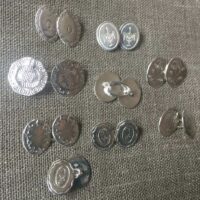
Sleeve buttons were used on the sleeves of men's shirts and women's shifts from the early 18th to the early 19th century. Cuff links are often confused with sleeve buttons but are structurally different. Sleeve buttons have been found in such numbers at archeological sites from Ft. Michilimackinac, Michigan to Williamsburg, Virginia it is believed people of all economic standing wore sleeve buttons. Further evidence to suggest poor people wore sleeve buttons may be seen in Jack, Hove Down - With a Grog Blossom Fever. Sleeve buttons were issued to soldiers of several military regiments including the 17th of Foot in 1776 and the 42nd Royal Highland Regiment in 1778. These buttons are made of the highest quality pewter 1/2" buttons copied from an original in a private collection. For example in 1773 in The Virginia Gazette an ad included "RUN away . . . two WHITE SERVANT MEN, namely . . . an indented Servant . . . he is by Trade a Butcher, and can do many other Things, such as Gardening and Farming . . . can read, write, and keep Accounts . . . He . . . took with him . . . a Parcel of Rings and Sleeve Buttons for Sale.". The picture shows the sleeve buttons front and reverse to illustrate the figure-eight attachment. We sell these buttons by the set which includes enough buttons for one shirt. In other words two pairs of buttons each pair connected by a figure-eight attachment. |
![]() |
|
$9.00 - Flower Pewter Set |
|
18th Century Plain Sleeve ButtonsSleeve buttons were used on the sleeves of men's shirts and women's shifts from the early 18th to the early 19th century. Cuff links are often confused with sleeve buttons but are structurally different. Sleeve buttons have been found in such numbers at archeological sites from Ft. Michilimackinac, Michigan to Williamsburg, Virginia it is believed people of all economic standing wore sleeve buttons. Further evidence to suggest poor people wore sleeve buttons may be seen in Jack, Hove Down - With a Grog Blossom Fever. Sleeve buttons were issued to soldiers of several military regiments including the 17th of Foot in 1776 and the 42nd Royal Highland Regiment in 1778. These buttons are made of excellent quality 1/2" domed buttons and are available in brass and German silver. For example in 1776 in Shrewsbury, New Jersey there was "Stolen from a store . . . two or three hundred pair of brass sleeve buttons, New England make". The picture shows the button front and reverse to illustrate the figure-eight attachment. We sell these buttons by the set which includes enough buttons for one shirt. In other words two pairs of buttons each pair connected by an attachment. |
![]() |
|
$10.00 - German Silver Set |
|
Pewter Death Head ButtonsDeath head buttons were a popular 18th century button style of thread or "Dorset" button. Often metal buttons were cast or stamped in various metals to imitate the popular pattern. Our death head buttons are cast of the highest quality pewter and hand finished to perfection. In The Virginia Gazette of 1769, "RUN away . . . two Scotch servants, one a man, a tailor by trade . . . took with him a cloth coloured frieze coat with white metal death head buttons". |
![]() |
|
$1.00 each 5/8" |
|
Pewter Basket ButtonsBasket buttons were a popular 18th century style of thread or "Dorset" button. Often buttons were cast or stamped in various metals to imitate the popular pattern. These buttons are identical to some labled as French buttons and pictured on page eight in Gentlemen on the Frontier: A Pictorial Record of the Culture of Michilimackinac. Our basket buttons are cast of the highest quality pewter and hand finished to perfection. In The Virginia Gazette of 1774, "RUN away . . . an indented Servant Man . . . by Trade a Tailor; had on, when he went away, a dark blue Coat with Silver Basket Buttons". |
![]() |
|
$1.00 each 5/8" |
|
Carved Metal ButtonsSpanish American buttons of c. 1750 to 1820 were originally carved metal buttons but are now cast from the originals. Buttons like these are sometimes found in runaway descriptions as in The Pennsylvania Gazette "RUN away the morning of the 22d of August, 1772 . . . a servant LAD . . . speaks much on the north of Ireland dialect, of which country he is; he had on, when he went away, a grey superfine broadcloth coat, with a scarlet collar, and carved silver washed buttons". |
![]() |
|
$1.50 - 3/4" Pewter | |
Domed Metal ButtonDomed buttons were common throughout the 18th and into the early 19th century. These buttons are made of the highest quality brass or German silver with soft rounded edges. In The Virginia Gazette in 1776, "A HORSE THIEF . . . he is as consummate a Villain as was ever imported from England . . . He is an expert Gunsmith (which, however, he will not own) and if he is enlisted for a Soldier will be very useful in repairing Guns, but must have a sound Lashing before he will do it as it ought to be. He stole . . . a white Sagathy Coat, double breasted, with yellow Metal Buttons; a brown Surtout Coat, double breasted, with white Metal Buttons". |
![]() |
|
$1.40 - 1/2" Brass $1.65 - 1/2" German Silver |
|
Domed Metal Button
|
![]() |
|
$1.50 - 3/4" Brass $1.70 - 3/4" German Silver |
|
Flat German Silver ButtonsFlat German silver buttons became more popular during the early 19th century. These are the buttons called for in the US State Militia Coat. Although generally speaking buttons were becoming more flat as time went from the 15th to the 19th century there is a lot of variation. In . The Virginia Gazette of 1739 "RAN away . . . Two Servant Men, and a Lad . . . [one of the men] is a Blacksmith by Trade. Had on, when he went away, a brown Plains Coat with white flat Metal Buttons . . . The other Man . . . is a Shoe maker . . . Had on, a light colour'd Coat with flat Metal Buttons". |
![]() |
|
$1.65 - 3/4" Flat German Silver |
|
Foliated Script I Pewter ButtonThese buttons are cast from an original button and are made of high quality lead free pewter. These are the buttons used by the U.S. Army for their War of 1812 Roundabouts. Script I buttons were cast in the tens of thousands. So many script one buttons were cast that they stayed in use into the American Civil War. |
![]() |
|
$1.00 each - 5/8" Foliated Script I Pewter |
|
Flat Pewter ButtonPlain flat pewter buttons were often used on both civilian and military clothing. Many original coats show a cord being passed through the button shank to secure the buttons in place. Complete directions for attaching buttons using this method are included on page 22 of The Workman's Guide to Plain Sewing. In The Virginia Gazette in 1751 "RAN away . . . a likely well-set Virginia-born Negro Fellow . . . had on . . . a blue Double-breasted Jacket, with slash'd Sleeves and Pewter Buttons". |
![]() |
|
$1.50 each - 1" Flat Pewter |
|
Hooks and EyesHooks and eyes made of blackened wire are available and sold by the set. We also provide hand made solid brass hooks and eyes. Directions for securely sewing hooks and eyes are found in The Lady's Guide to Plain Sewing Book II. These were used to close garments such as men's coats and to cock hats. They may be used in conjunction with a pair of ties to help keep a women's cloak shut as well and there is an unusual sample from 1738 The Virginia Gazette of a "RUN away . . . a Servant Man . . . he is an Irishman . . . He carried . . . one Half thick Wastecoat, with Hooks and Eyes, instead of Buttons". In 1774 in >The Proceedings of the Old Bailey, London during the trial of some highwaymen a witness stated, "I am a taylor: I made this coat for the prosecutor; I finished it on the 9th of April; I am sure it is the same; I made it myself; I know my own work perfectly well; the hooks and eyes are taken out, here are the marks where they were." We also have hook and eye tape. Add Small Wire Hook and Eye Set to Cart Add Wire Hook and Eye Set to Cart Add Brass Hook and Eye Set to Cart small 3 sets for $0.50 |
Brass hook and eyes are at the top and are about 3/4" long and hooked they are about 1 1/2". Each medium hook and eye is 1/2" long and hooked they are 7/8" long. Each large is about 3/4" long and hooked they are 1 3/8" long. ![]() The small hook is 1/2" (1.3 cm), the eye is 1/4" (6.4 mm) long. Linked they are just short of 3/4" long. ![]() |
Thread & Covered Buttons | Horn Buttons | Metal Buttons | Other Closures