Men's PatternsWe offer several companies' patterns. They generally come in various sizes. Shirts | Breeches and Trousers | Coats, Jackets, and Regimentals |
Kannik's Korner Shirt 1750-1800Man's pullover shirt with shoulder reinforcement panels, neck and underarm gussets, to be made plain for the common man or fancy with chest and wrist ruffles for the gentleman. In The Providence Gazette of 1771, "RUN away . . . an Englishman . . . Had on . . . a Check Shirt, with white Wristbands". This pattern calls for between 3 1/4 to 3 3/4 yds. but we feel about 2 1/3 yards is enough for one shirt or 4 yards for two shirts. Shirts may be made of off white linen shirting, 5.5 oz.. For poorer impressions unbleached linen, 6.5 oz or for a warm winter shirt white wool flannel. Three or (more commonly) four thread shirt buttons may be used. Many origianl shirts had two thread shirt buttons at the collar and removeable sleeve buttons at the wrist band. Some argue for cloth covered buttons. For hand sewing the shirt use 35/2 linen thread to match. For officer's and gentlemen's shirts try the very fine and tightly woven linen shirting, 5.75 oz. with very fine 2.8 oz. linen bosom ruffles. Includes all sizes XS-XXXL $12.00 |
![]() |
![]() |
Kannik's Korner Shirt 1790-1830Man's pullover shirt with shoulder reinforcement panels, neck and underarm gussets, to be made plain for the common man or fancy with chest ruffles for the gentleman. This pattern will make a shirt that is identical to this extant shirt at the National Maritime Museum. In The Providence Gazette of 1795, "RAN AWAY . . . an indented Servant . . . had on, and carried with him . . . 2 striped blue and white [wool] Flannel Shirts, and 1 white Tow and Linen Shirt". This pattern calls for between 3 1/4 to 3 3/4 yds. but we feel about 2 1/3 yards is enough for one shirt or 4 yards for two shirts. Shirts may be made of off white linen shirting, 5.5 oz.. For poorer impressions unbleached linen, 6.5 oz or for a warm winter shirt white wool flannel. Three or (more commonly) four thread shirt buttons may be used. Many origianl shirts had two thread shirt buttons at the collar and removeable sleeve buttons at the wrist band. Some argue for cloth covered buttons. For hand sewing the shirt use 35/2 linen thread or finer 60/2 linen thread to match. For officer's and gentlemen's shirts try the very fine and tightly woven linen shirting, 5.75 oz. with very fine 2.8 oz. linen bosom ruffles. Includes all sizes XS-XXXL $12.00 |
La Fleur de Lyse 18th Century French Style Man's ShirtThis very well documented pattern comes complete with clear illustrations and instructions to make thread buttons with options for ruffles on the sleeves and bosom slit. Also included are instructions and illustrations to make a French workman's cap and each of the three types of neck cloths no man should go without - stock, cravat and handkerchief. Fits all neck sizes 14 1/2" to 17 1/2". This pattern calls for between 3 1/4 to 3 3/4 yds. but we feel about 2 1/3 yards is enough for one shirt or 4 yards for two shirts. Shirts may be made of off white linen shirting, 5.5 oz.. For poorer impressions unbleached linen, 6.5 oz or for a warm winter shirt white wool flannel. This pattern specifically calls for two thread shirt buttons at the collar and removeable sleeve buttons at the wrist band. For hand sewing the shirt use 35/2 linen thread or finer 60/2 linen thread to match. For officer's and gentlemen's shirts try the very fine and tightly woven linen shirting, 5.75 oz. with very fine 2.8 oz. linen bosom ruffles. This very fine 2.8 oz. linen is also what is used to make neck, handkerchiefs, cloths, and stocks. $21.95 Add La Fleur de Lyse 18th Century French Style Man's Shirt to Cart |
![]() |
![]() |
Kannik's Korner Man's AccessoriesA mid to late 18th century working man's mittens, cap, apron, neck stock, and balaclava. Suitable for 1740s to 1830s. In The Virginia Gazette of 1775, "RUN away . . . a convict servant man . . . He took with him . . . a stock, and brass stock buckle". $12.00 A buckle for your stock. |
Kannik's Korner
|
![]() |
![]() |
Country Wives
|
JP Ryan BreechesMen's fall front breeches, with front pockets, optional waistband watch pocket and tabs for knee buckles. These breeches have a fit for the third quarter of the 18th century, with a short rise, fitting the torso lower in the front than in the back. In The Providence Gazette of 1772, "RAN away . . . a bound Servant . . . had on, and took with him . . . Woollen Breeches of a grey Colour, mended some". To make this pattern you will need about 2 yards of twill linen (ticken or Russia drill work well), tightly woven linen, or medium weight wool, 15 5/8" buttons or button molds, 35/2 or 50/3 linen thread, 18th century breeches buckles, and one roll 1/4" cotton twill or 1/2 yard linen tape. To fit waist sizes 30-32; 34-36; 38-40; 42-44; 46-48. $18.00 |
![]() |
Mill Farm Man's BreechesMen's fall front breeches, with front pockets. This pattern has descriptions for optional waistband watch pocket, making the knee length breeches into trousers, a slight variation to make them military, and tabs for knee buckles. These breeches have a fit for 1770 to 1800, with a short rise, fitting the torso lower in the front than in the back. In The Providence Gazette of 1777, "Deserted from my Company of Artillery, in Col. Elliot's Regiment . . . an Irishman . . . Had on . . . Sky blue Broadcloth Breeches." To make this pattern you will need about 2 yards of twill linen (ticken or Russia drill work well), tightly woven linen, or medium weight wool, one yard light weight linen for a lining, 7 3/4" buttons or button molds, 10 5/8" buttons or button molds, 35/2 or 50/3 linen thread, and one roll 1/4" cotton twill or 1/2 yard linen tape. Most extant breeches, runaway descriptions, and period artwork show buckles at the knee bands. For this option 18th century breeches buckles, will be required. To fit waist sizes 28-30; 32-34; 36-38. $10.00 |
![]() |
![]() |
Kannik's Korner Outer BreechesMen's outer breeches or 'slops'. These naval style trousers have a mid-18th century fit, with a short rise, fitting the torso lower in the front than in the back. To make these you will need between 1 5/8 to 2 3/4 yards of 11 or 13 oz. Russia sheeting, 6.5 or 9 oz. unbleached linen, indigo stripe or similar heavy linen fabric, off white or unbleached 35/2 linen thread 1/4" cotton twill tape, and one or two 1" buttons or button molds. Pattern for all waist sizes 32"-52" $14.00 |
Kannik's Korner Man's Trousers High-Waisted 1790-1810
|
![]() |
![]() |
JP Ryan WaistcoatThis late 1740s to early 1780s waistcoat may be made in long or short versions, with or without sleeves, with three different center front lines, depending on period and personal preference. In The Virginia Gazette of 1775, "RAN away . . . two English convict servant men . . . [one of them] born in Cambridgeshire . . . had on a . . . brown cloth jacket, with sleeves". Fabric requirements vary greatly but generally are about 1 1/4 yard for the front (add a yard if you are adding sleeves. Either linen or wool may be used), 1 yard for the back (often waistcoats had a cheaper back fabric such as 6.5 oz. unbleached linen), 2 yards for a lining (again add a yard to line sleeves oatmeal handkerchief linen 3.7 oz. works well) and one yard interfacing (try 11 oz. Russia sheeting). Notions required are about 20 5/8 to 1" buttons or button molds and 35/2 or 50/3 linen thread for hand sewing. Please specify chest size 40-48, with one size per pattern. $18.00 |
Kannik's Korner Double Breasted Short JacketThis mid to late 18th century workman's jacket with sleeves includes three sleeve style variations. Choose 2 3/8 yards of a twill linen, tightly woven linen, or wool for the body. You will need 2 3/8 yards for a lining such as oatmeal 3.7 oz. linen or for extra warmth wool flannel. You will also need about a half yard of interfacing such as 11 oz. Russia sheeting. For notions 35/2 or 50/3 linen thread, 8 to 10 yards of 1/4" linen tape, 16 7/8" button molds, and between 4 to 8 3/4" button molds for the sleeves will be needed. Pattern includes sizes 38" to 50" $16.00 |
![]() |
![]() |
Mill Farm Banyan and CapWorn at home by middling to gentry as loungewear and even when greeting guests of lower status and sometimes out-doors from 1750 to 1800 and possibly later. Chest sizes 34 to 44 in one package. Choose 4 yards of a cotton print or heavy silk fabric, and an optional 4 yards oatmeal 3.7 oz. linen or light weight China silk for a lining and 1/2 yard of 11 oz. Russia sheeting for interfacing. For notions 50/3 linen thread, and 6 7/8" buttons or button molds or 4 pair of frogs. $18.00 |
Mill Farm Greatcoat PatternExtra warmth for the gentleman is added with a choice of collars and capes providing variations appropriate for 1750 to 1800 in this greatcoat pattern. To make this greatcoat you will need 5 yards of heavy weight wool, nine 1" buttons. 1/2 yard interfacing (try our 11 oz. Russia sheeting), and 50/3 linen thread. Available in one size only, up to size 44. $18.00 |
![]() |
![]() |
JP Ryan 1750s Coat with Military VariationsAppropriate for either civilian or military wear, this coat has very full skirts, deep cuffs, a straighter front line and roomier sleeves than coats worn after the 1770s. The body of the coat fits close to the person with armholes set high and back to reinforce a correct, 18th century posture. Variations in lapels and cuffs are included to adapt to many regimental styles. Available in sizes 40 - 52, one size per pattern. $24.00 |
JP Ryan Frock CoatGentleman's coat with collar, which can be made full length or short coat style appropriate for 1770 to 1780 in this fully illustrated, instructional, full size pattern. To make this coat between 2 7/8 to 3 3/8 yards of wool broadcloth or twill linen and about the same amount for a lining of oatmeal 3.7 oz. linen or for extra warmth wool flannel is required. Notions needed are about 1 yard 11 oz. Russia sheeting interfacing, between 12 to 26 3/4 to 1" buttons or button molds, 4 1/2 to 3/4" 5/8 to 1" buttons or button molds, and 50/3 linen thread. There is an option to bind the coat in 1/2" metallic lace or 1/2" wool tape. Please specify chest size 40-48, with one size per pattern. $18.00 |
![]() |
![]() |
French Soldier's Small Clothes
|
Justicorps (Military Coat)
|
![]() |
1730s to early 1740s Frock CoatThis is the first pattern produced specifically for the early 18th century with the curved front and full skirts. Suggestions are provided for embellishing the coat. Full size paper pattern, detailed separate instructions for either machine or period hand sewing, and historical notes are all provided. We are discontinuing this pattern line and are now offering this pattern at wholesale price. Only one is left. We also have a copy of Kass' Common Man's or Sailor's Jacket we will offer at the same price. To make this coat between 3 to 5 yards of wool broadcloth (the pattern calls for 5 yards but Kass' website calls for 3 yards. Three yards should be plenty.), the same amount for an optional lining of oatmeal 3.7 oz. linen or light weight China silk and 1 yard of 11 oz. Russia sheeting interfacing is required. Notions needed are between 35 to 50 5/8 buttons or button molds, 35/2 or 50/3 linen thread, optional wool felt padding for shoulders and skirts, and optional binding in 1/2" metallic lace or 1/2" wool tape. This pattern specifically suggests passementerie (thread covered) buttons of which directions for one type may be found in "Death Head" buttons their use and construction. This pattern includes chest sizes 34-54.
|
![]() |
![]() |
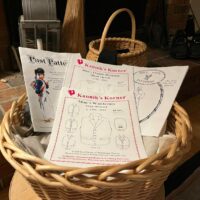
Past Patterns 1804 U.S. Army Issue Artillery CoatThis shell pattern may be used for military patterns circa 1796-1809. This includes patterns for the Lewis and Clark bicentennial celebrations. The pattern is based on U.S. Army correspondence between 1803-1805 from the National Archives as well as garments and drafting systems. The pattern contains historical notes by Robert G. Stone describing the 1804 artillery coat as well as how to adapt the pattern for use in making a Lewis and Clark private's coat. The pattern also contains illustrated instructions for hand stitches that are typical of early 19th century tailoring. Saundra Ros Altman has written and illustrated the sewing and fitting instructions. This pattern is available in army issue sizes 1 [35], 2 [37] and 3 [39] and modern sizes 4 [41], 5 [43], 6 [45], 7 [47], 8 [49], 9 [50], 10 [52], 11 [54], and 12 [56]. Of 54 inch wool cloth: Sizes 1 through 3 require 2 yds.; 4 through 6 require 2-1/4 yds.; 7 and 8 require 2-3/4 yds.; 9 through 12 require 3-1/8 yds. $30.00 Add Past Patterns 1804 U.S. Army Issue Artillery Coat to Cart |
Past Patterns Napoleonic Era British Foot Soldier's Jacket circa 1806-1820This pattern is drafted. That means that it was created using early 19th century pattern drafting systems, the specifications from the British military archives and original issue uniforms. It has the small back and deep set sleeves typical of British military uniforms for the years 1806 to 1820. The pattern contains templates for placing the looping on the jacket left and right sides, the cuffs, and wings. In addition to construction instructions the Sewing Guide contains instructions for Hand Stitches and How to Create the Five looping shapes. Saundra Ros Altman has written and illustrated the sewing and fitting instructions. James Kochan and Henry Cooke IV edited the text and Looping Shapes section. This pattern is available in army issue sizes 1 [36], 2 [38], 3 [40], 4[42] and modern sizes 5 [44], 6 [46]. Of 54 inch wool cloth the jacket: Sizes 1 and 2 require 1-2/3 yds.; 3 requires 1-3/4 yds.; 4 and 5 require 1-7/8 yds.; 6 requires 2 yds. $30.00 Add Past Patterns British Foot Soldier's Jacket ca. 1806-1820 to Cart |
![]() |
Shirts | Breeches and Trousers | Coats, Jackets, and Regimentals