The sign of the unicorn. A fabric shop for 18th century reenactors and historians.

Women's Patterns

We offer several companies patterns. Each company has its own sizes available.

Shifts | Caps and Hose | Stays | Gowns | Outerwear

home
Top

Shifts

Kannik's Korner Woman's Shift second half of the 18th century KK 6102 is the best pattern for American Revolution historic reenactor and museum interpreter clthoing.

Kannik's Korner Woman's Shift
1750-1800

English Style Shift (Chemise) A full size pattern of this undermost garment, with stitching instructions, including whip gathered ruffle. This pattern is a composite of similar characteristics found in three original shifts now in museum collections, plus additional documentation. In The Pennsylvania Gazette of 1772 "Run away . . .  an indented servant woman . . .  had on, and took with her . . .  3 coarse shifts, one of which is a homespun, with a pair of fine sleeves, one ozenbrigs ditto, and one coarse tow ditto, with broken ruffles on the same".

Most shifts require about 2 1/2 yards for poor to middling sort 3.7 oz. oatmeal linen or off white 5.5 oz. linen shirting. Suggested shift fabric for middling to gentry off white 5.5 oz. linen shirting or white 3.7 oz. linen and 60/2 linen thread of either white or unbleached to match fabric.

Sizes per pattern, S-M-L-XL-XXL-XXXL.

$12.00

Add Kanik's Korner Woman's Shift 1750-1800 to Cart

home
Top

Kannik's Korner Woman's Shift
1790-1820

A full size pattern of this undermost garment, useful for Empire and Federal style gowns, with a drawstring neckline to help adjust shift to gown neckline, and short sleeves to go with the fashion of the period. Based on original cutting directions, with construction techniques from several extant garments.

Most shifts require about 2 1/2 yards for poor to middling sort 3.7 oz. oatmeal linen or off white 5.5 oz. linen shirting. Suggested shift fabric for middling to gentry off white 5.5 oz. linen shirting or white 3.7 oz. linen and 60/2 linen thread of either white or unbleached to match fabric and one roll of 1/8" cotton twill tape.

Includes sizes S-M-L-XL-2XL-3XL.

$12.00

Add Kannik's Korner Woman's Shift 1790-1820 to Cart

Kannik's Korner Woman's Shift 1790 to 1820 KK 6103 is the best pattern for Fedrilist, Lewis and Clark era, and War of 1812 historic reenactor and museum interpreter clthoing.
home
Top
JP Ryan Basic Wardrobe pattern for second half of the 18th century historic reenactor and museum interpreter clthoing.

JP Ryan Basic Wardrobe

Contains pattern diagram for shift in all sizes, plus illustrated directions for petticoat, apron and neck handkerchief. Patterns included for short gown and pocket. In The Pennsylvania Packet of 1783 "Ran away . . .  an Irish servant Girl . . .  Had on and took with her, a green skirt, dark calicoe short gown, white stockings, leather shoes with low heels, two striped lincey petticoats, a striped red calicoe short gown".

One size short gown per pattern, bust sizes 32-34, 36-38, 40-42, 44,46, 48-50.

$18.00

Basic Six Piece Wardrobe

Add JP Ryan Basic Wardrobe to Cart

home
Top

La Fleur de Lyse Canadienne de la Nouvelle-France circa 1740-1760

A full pattern for the mantelet (known as a bedgown in English) is included here with two sleeve versions. This shift pattern has a gathered sleeve more common for the 1740-1760 opposed to the fitted sleeve which was becoming popular in the 1770s. Also included are instructions for the petticoat, neck handkerchief and apron with two bib styles.

The mantelet requires 1 1/2 yards light-weight wool, linen, cotton print, and 1 1/2 yards, light-weight linen for a lining. Notions are 8 1/2 yards 1" cotton twill tape or 7/8" worsted twill tape in a coordinating color, and 35/2 or 50/3 linen thread.

The shift requires 2 1/2 yards white or unbleached linen.

The petticoat requires 2 yards light weight wool, linen, or cotton print, 5 1/2 yards 1" cotton or 7/8" worsted twill tape in a coordinating color, and 2 1/4 yards 1/2" cotton or linen tape.

The apron needs 1 1/4 yards linen and 1/4" cotton or linen tape.

The handkerchief requires only one yard of 2.8 oz. linen or organdy and fine 90/2 linen thread.

$21.95

Add La Fleur de Lyse Canadienne ca. 1740-1760 to Cart

La Fleur de Lyse Canadienne de la Nouvelle-France circa 1740-1760 pattern is the best shift, or in French chemise, pattern for French and Indian War historic re-enactor's and museum interpreter's clthoing.
home
Top

Caps and Hose

Country Wives
Workwoman's Outdoor Bonnet c. 1789 - 1818

These bonnets were commonly worn by Western European (British, French) and North Amarican women of labouring to middling classes. These were often worn by older women and usually over a day cap. This pattern includes suggestions for fabrics, documentation, and options in the construction. In The Proceedings of the Old Bailey, London of 1812 during the trial it was recorded, "though she had a large bonnet on at the time".

$15.00

Add Workwoman's Outdoor Bonnet to Cart

Country Wives Workwoman's Outdoor Bonnet is good for federalist, new republic, Napoleonic, Lewis and Clark, and War of 1812 historic reenactor's and museum interpreter's clothing.
home
Top
Kannik's Korner Woman's Cap and Bonnet KK 6601 works well for mid to late 18th century historic re-enactor's and museum interpreter's clthoing.

Kannik's Korner Woman's Cap and Bonnet

Based on original 18th century directions, this pattern is appropriate for 1775 to 1800 although similar cap and bonnets were used earlier. In some cases bonnets outnumber hats such as in New Jersey runaway descriptions. One from 1776 includes a servant woman who left with "a black silk bonnet."

A half yard of 2.8 oz. linen is enough for two caps. Notions for the cap include 1/8" white cotton twill tape and 90/2 white linen thread.

The bonnet requires about 2/3 yd. worsted wool or black brown, green, blue, or drab. Notions for the bonnet include 3/4 yd. of 1/4" wide gorsgrain ribbon, and both heavy 16/2 linen thread and medium 35/2 linen thread.

$10.00

Add Kannik's Korner Woman's Cap and Bonnet to Cart

home
Top

Kannik's Korner
Women's/Men's Stockings, Women's Pockets, and Mitts

A full scale, multi-size, pattern for constructed stockings for men or women, with instructions for custom fitting. Can be made of knitted cloth, or of linen cut on the bias (good for 17th, 18th, early 19th century). Five pocket styles, including three mid-18th century (English, Scotch, & Italian), and two second half 18th century from America. Also includes a pattern for women's common linen mitts, cut on the bias (one size). In The Pennsylvania Packet of 1779 "Ran away . . .  a servant woman . . .  She stole and carried off . . .  one pair of white cotton mitts".

Includes stocking sizes S-M-L-XL-2X-3X Pattern

$10.00

Add Kannik's Korner Stockings, Pockets & Mitts to Cart

Kannik's Korner Stockings, Pockets, and Mitts KK 6001 works well for mid to late 18th century historic reenactor's and museum interpreter's clthoing.
home
Top
La Fleur de Lyse Caps and Coif pattern is a good pattern for mid 18th century historic reenactor's and museum interpreter's clthoing.

La Fleur de Lyse
Caps and Coif
Mid 18th Century

Patterns for three styles of caps plus a long lappets cap and coif are included here. In addition a pattern to make a pocket is also included. In The Pennsylvania Gazette of 1772 "Run away . . .  an indented servant woman . . .  had on, and took with her . . .  a clean cap, with a black sattin ribbon, tied round her head, and brought under her chin".

Suggested cap fabric 100% white handkerchief linen 2.8 oz, organdy, or for poorer caps off white 3.7 oz. linen

Suggested pocket fabrics 100% unbleached linen, 6.5 oz and 100% off white linen shirting, 5.5 oz

$21.95

Add La Fleur de Lyse Caps and Coif Mid 18th Century to Cart

home
Top

Kannik's Korner Woman's and Girl's Caps

This pattern includes many styles of everyday headgear used from 1740-1820. Often women try several styles before settling with one that works well for them. In The Pennsylvania Gazette of 1770 "Run away . . .  an Irish servant girl . . .  wears sometimes ribbons, and sometimes caps . . .  had on, and took with her . . .  two caps for a child, and linen to make more".

One yard of organdy, 2.8 oz. linen or for poorer impressions off white 3.7 oz. linen is plenty for most caps. Most styles require 1/8" white cotton twill tape and 90/2 or 120/2 linen thread.

$12.00

Add Kannik's Korner Woman's and Girl's Caps to Cart

Kannik's Korner Woman's and Girl's Caps 1740-1820 Everyday Headwear KK 6602 is great for 18th and 19th century historic re-enactor's and museum interpreter's costume.
home
Top
Country Wives Caps for the Upper Crust is a good pattern for early republic or fedrilist period historic re-enactor's and museum interpreter's clthoing.

Country Wives
Caps for the Upper Crust 1790 to 1820

These cap patterns were all created by studying art work of wealthy women in the United States and United Kingdom as well as extant caps from many museums. These caps are more complicated to construct, use several styles and widths of lace, and are more time consuming than many other cap patterns. In The Pennsylvania Gazette of 1773 "FRANCES MOLTON CRANMER was indicted for burglariously breaking and entering . . .  stealing therein . . .  two double lace caps, value 15s. a dress lace cap, value 10s.".

$15.00

Add Caps for the Upper Crust to Cart

home
Top

18th Century Wired Cap

Worn mostly by the middling to gentry classes but is seen in portraits on 'my lady's maids'. This cap was worn as early as 1745 but is most commonly seen from the late 1760s to early 1770s. Required milliner wire is included in the pattern. In The Providence Gazette of 1763 "RAN away . . .  a likely lusty Mulatto Servant Woman . . .  She is extremely nice in her Head Attire, which is generally ornamented after the modern Fashion".

To make this cap you will need 2/3 yard of very fine white linen or organdy and fine 90/2 or 120/2 linen thread. There is an option to add trimmings such as narrow silk ribbon bows to 1 to 1 1/2" wide silk trimmings.

$8.00

Add 18th Century Wired Cap to Cart

Cap pattern for those women of fortune for French and Indian War historic re-enactor's and museum interpreter's clothing.
home
Top
JP Ryan Caps pattern is a good pattern for mid to late 18th century historic re-enactor's and museum interpreter's clthoing.

JP Ryan Caps

A simple cap to cover the head, which can be worn with the ears turned toward or away from the face, as desired. An undress cap to be constructed in mid-weight white linen. In The Pennsylvania Gazette of 1773 "Run away . . .  a Dutch servant girl . . .  had on, when she went away, a round ear'd cap".

$7.00

Add JP Ryan Caps to Cart

home
Top

Woman's Caps 1720 to 1800

Women often try several caps before they find one that compliments their face and they feel comfortable wearing. This pattern provides four different styles that may be further adorned with ribbons to provide individual touches. In The Pennsylvania Gazette of 1773 "Run Away . . .  a Dutch servant woman . . .  had on an English cap, with a coarse lawn border".

For most of these caps you will need 1/2 to 3/4 yard of very fine white linen or organdy, 1/8" cotton twill tape, and fine 90/2 or 120/2 linen thread. There is an option to add trimmings such as narrow silk ribbon bows.

$9.00

Add Woman's Caps 1720 to 1800 to Cart

Cap pattern for French and Indian War, Revolutionary War, and early republic historic re-enactor's and museum interpreter's clothing.
home
Top
Country Wives pattern is a good pattern for early 19th century historic re-enactor's and museum interpreter's clthoing.

Country Wives

A Variety of Lappet Caps mid 18th to early 19th Centuries

Country Wives lappet caps were commonly worn by the French in both Europe and North America and were often worn by country women, farmers, maids, and genteel ladies. This pattern includes suggestions for fabrics, documentation, and options in the construction. In The Proceedings of the Old Bailey in London of 1781 the trial recorded, "The prisoner, Elizabeth Tenant, gave me a piece of lace lappet for a cap, and a cap caul".

$15.00

Add A Variety of Lappet Caps to Cart

home
Top

Country Wives
Caps for the Working Poor Mid 18th to Mid 19th Century

All of these patterns are based on originals in museum collections made of sturdy linen. They may be made for wealthier impressions by making them of finer fabrics. The full pattern, directions, and documentation come in this pattern. In The Virginia Gazette of 1774, "RUN away from Forceput two convict servant women . . .  she took with her . . .  linen and muslin caps".

$15.00

Add Caps for the Working Poor to Cart

Cap pattern for French and Indian War, Revolutionary War, and early republic historic re-enactor's and museum interpreter's clothing.
home
Top
Country Wives pattern is a good pattern for early 19th century historic re-enactor's and museum interpreter's clthoing.

Country Wives
British Regency Caps 1780 to 1820

View A, B, & D are seen very frequently from the late 18th to early 19th century by laboring to middling sort women. View E is a cap worn by working class women shown in many of Pyne's British sketches. View C is an unusual example of a naive American young woman of about 1810. These styles of caps often were adorned with silk ribbons in bright pastel colors in widths from medium to quiet wide.

$15.00

Add A British Regency Caps to Cart

home
Top

Country Wives
Beribboned Caps 1780 to 1810

This includes a selection of the overly large caps popular at the end of the 18th century. These caps are decorated with extravagant silk ribbons and includes instructions how to make a variety of ribbon rosettes. In the Proceedings of the Old Bailey, London, in 1791 "the prisoner robbed me of all my clothes . . .  she had my cap and ribbon on".

$15.00

Add Beribboned Caps to Cart

Cap pattern for early republic and fedrilist period historic re-enactor's and museum interpreter's clothing.
home
Top

Stays

JP Ryan Stays pattern is the best, for pattern for French and Indian War, 1770s, and American War for Indipendance historic re-enactor's and museum interpreter's clthoing.

Stays by JP Ryan

Strapless stays are designed for comfort and give a cylindrical shape to the torso while allowing full freedom of movement of the arms and shoulders. The fully illustrated directions are included for any necessary alterations required to fit your figure. These stays are appropriate for late 18th century wear and incorporates features from extant 18th century stays in the National Museum of American History and the Los Angeles County Museum of Art. In The Virginia Gazette of 1774 "Run away . . .  a Welsh woman . . .  had on, and took with her . . .  an old pair of green coloured stays".

Comes in sizes 6 through 24 for bust sizes 32-50.

$15.00

Add JP Ryan Stays to Cart

home
Top

Mill Farm 18th Century Jumps or Leather Stays

Jumps include options for a front and or back laced, lightly boned undergarment that is perfect for work, undress, or a first pair of stays. Leather stays were worn by poor women. In The Pennsylvania Packet of 1776 "Ran away . . .  an English servant girl . . .  had on and took with her . . .  a pair of leather stays".

Comes in sizes 8–18.

$8.00

Add Mill Farm 18th Century Jumps or Leather Stays to Cart

Mill Farm 18th Century Jumps or Leather Stays pattern is the best jumps pattern for late 18th century historic re-enactor's and museum interpreter's clthoing.
home
Top

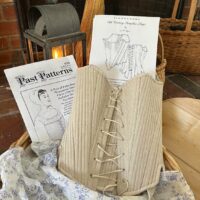
#030: A Pair of Transition Stays - Pattern Fashionable Circa 1796-1806

This pattern was pulled, with permission, from the extant garment in the Danvers' Historical Society in Danvers, Massachusetts. The threads appear to be hand spun and the fabric appears to be hand woven of linen warp and cotton weft. The thread count is approximately 40 warp and 36 weft. The pieces are sewn together with linen thread, perhaps the thread used to weave the fabric. The stiffening is whalebone. While the front is fully-boned the back and sides are partially boned. Variations of the front boning from Conner Prairie Museum in Fishers, Indiana and The Chester County Historical Society in West Chester, Pennsylvania are included with the pattern.

Detailed Historical Notes explaining and documenting what is unique about a pair of transition stays are included in the pattern package.

The pattern comes in sizes 8-14, 16-20, and 22-26 all with cup sizes B, C, and D. The following sizes are layout out on 45" wide fabric. Sizes 8 through 14 require 1/2 yd. fashion fabric and 2/3 yd. lining, sizes 16 through 20 require 3/4 yd. fashion fabric and 7/8 yd. lining and sizes 22 through 26 require 7/8 yd. of fashion fabric and 1 yd. of lining.

$9.00

Metal Bands:

Past Patterns sells the set of metal bands that are inserted in the horizontal breast-bone casings that make a transition stays unique.

$3.00 a pair.

The stay is worn with Past Patterns Ca 1796-1806 Lewis & Clark Era Front Closing Gown (below).

Add Past Patterns #030: Transition Stays to Cart

Add Metal Bands to Cart

Stay pattern for Sandra Altmen's transitional, late 18th early 19th century stays for historic reenactors and museum interpreters.
home
Top

Gowns

Woman's Gown A Robe Polonaise ca. 1770 to 1785

This pattern may be used to make a simple day gown with the option to wear it 'a la polonaise' or tucked up at the hips. Included are directions for the petticoat and hip pads. In The Pennsylvania Gazette of 1771, "Run away . . .  living in Philadelphia . . .  a Welsh servant girl . . .  she had on, and took with her, when she went away, two calicoe gowns, one dark, the other a purple in diamonds, much worn".

This gown requires approximately 4 yards (extra yardage is required if stripes or patterns are being used) of linen (striped linens were common), cotton print, or light weight wool fabric for the gown, 3/4 yard of light weight linen for the bodice lining, 1/2 yard linen or China silk for the sleeve lining. A petticoat will require an additional 2 yards of linen, cotton print (to match the gown), or light weight wool. Notions required are one spool of 80/3 or 60/2 linen thread, 10 large hook and eyes, 3 1/2 yards of half inch cotton twill or linen tape, 2 yards one inch cotton twill tape, 2 yards 1/4" silk ribbon to match robe, 2 tiny (1/2") buttons, 1 yard plain linen for hip pads, and stuffing material.

$12.00

Add Woman's Gown A Robe Polonaise to Cart

Cap pattern for French and Indian War, Revolutionary War, and early republic historic re-enactor's and museum interpreter's clothing.
home
Top
Fig Leaf Open Robe Pattern for 18th century historic reenactor's and museum interpreter's costume.

Fig Leaf Patterns
Open Robe ca. 1771

This pattern includes a full packet of information with well documented directions for both open and closed robe gown with petticoat. In The Pennsylvania Gazette of 1772, "Run away . . .  an Irish servant girl . . .  had on when she went away, a long old green worsted gown".

To make this gown you will need about 4 yards (extra yardage is required if stripes or patterns are being used) of linen, cotton print, or light weight wool fabric for the gown and one yard of light weight linen for a lining. A petticoat will require an additional 2 yards of linen, cotton print, or light weight wool. Notions required are one spool of 80/3 or 60/2 linen thread, and hook and eyes long enough to close the front of the gown. Three yards of one inch cotton twill tape is required for the closed robe option.

8-18 (pattern fits 32" - 42" bust)
18R-28R (pattern fits 41" - 51" bust)

$25.00

Add Fig Leaf Patterns Open Robe ca. 1771 to Cart

home
Top

Fig Leaf Patterns
Work Dress ca. 1795

Empire gown of the transitional style with a higher waistline. The bodice front neckline is low and curved. The bodice also ends high under the bust and has three darts on each side for shaping and extends around the body as in the earlier" en fourreau" style. The shoulder strap is constructed in the same manner as earlier styles and has two sets of patches. The sleeves are two-piece construction with a narrow hem. In The Providence Gazette of 1796, "Ran away . . .  a Negro WOMAN . . .  She stole and carried off . . .  a light Calicoe new Gown, a striped Tow and Linen Gown".

Required fabric is about 4 yards (extra yards may be required when using a stripe or print) of linen, cotton print, or light weight wool fabric. Notions required are 2 2/3 yards of 1/4" cotton tape, 2 3/4" hooks and 35/2 or 50/3 linen thread.

8-18 (pattern fits 32" - 42" bust)
18R-28R (pattern fits 41" - 51" bust)

$25.00

Add Fig Leaf Patterns Work Dress ca. 1795 to Cart

Fig Leaf Work Dress for late 18th century historic reenactor's and museum interpreter's clothing.
home
Top

JP Ryan
Pet-en-l'air

The pet-en-l'air has a fitted torso without front waist seam, and a pleated sack back that extends from neckline to hem. Designed to be worn over stays, the Pet-en-l'air was popular from the 1750s to the 1770s.

Available in sizes 6-8 through 22-24.

$20.00

Pet-en-l'air (Robe à la Française)

Add JP Ryan Pet-en-l'air to Cart

JP Ryan Pet-en-l'air Pattern for mid to late 18th century historic reenactor's and museum interpreter's costume.
home
Top
JP Ryan Robe à l'Anglaise Pattern for mid to late 18th century historic reenactor's and museum interpreter's costume. French and Indian War and American Revolution saw this type of gown in use.

JP Ryan
Robe à l'Anglaise
or English Nightgown

1750-1780 May be constructed in a variety of ways. The two views shown offer a Robe à l'Anglaise en foureau as round gown with an apron front or as a Robe à l'Anglaise à La Polonnaise as an open robe with petticoat. Either view may be made as an open or closed robe. The most versatile gown of the 18th century! In The Virginia Gazette of 1774, "Run away . . .  two convict servant women . . .  [one of them] has on a new pompadour gown . . .  she took with her an old green gown".

For gown view A 4 1/2 yards or view B 5 1/2 yards linen, printed cotton (more may be needed when using stripes or prints), or medium weight wool, 1 yard, light weight linen for a lining. Notions required are hook and eyes or hook and eye tape, plastic feather boning, 35/2 or 50/3 linen thread and view A only requires 2 yards of 3/4" silk ribbon and 2 button molds 1/2" diameter. View B requires 1/2" twill tape for apron ties.

View A petticoat requires 2 1/2 yards linen, printed cotton (more may be needed when using stripes or prints), or medium weight wool, 2 1/2 yards 1" twill tape or 7/8" twill tape in a coordinating color, and 35/2 or 50/3 linen thread.

Available in sizes 8-22, one size per pattern.

$18.00

Robe à l'Anglaise

Add JP Ryan Robe l'Anglaise or English Nightgown 1750-1780 to Cart

home
Top

JP Ryan
Ca. 1770-1785
Caraco

Long jacket which may be worn down or up à la Polonaise, with optional ruching strip to be attached across center front to hold handkerchief in place. Available in sizes 6 through 20, two sizes per pattern. Includes sleeve ruffles and petticoat. In The Pennsylvania Gazette of 1775, "Run away . . .  an Irish servant maid . . .  took with her . . .  a small red striped long gown, with black spots between the stripes, mended under the arms with another sort of calico".

Sizes 32-24, 36-38, 40-42, 44-46

$18.00

Caraco

Add JP Ryan Caraco Ca. 1770-1785 to Cart

JP Ryan Caraco Pattern for mid to late 18th century historic reenactor's and museum interpreter's costume. American Revolution saw this type of gown in use.
home
Top
Mill Farm Riding Habit Pattern for mid to late 18th century historic reenactor's and museum interpreter's costume. French and Indian War and American Revolution saw this type of riding habit in use.

Mill Farm
Woman's Riding Habit Jacket and Waistcoat Pattern

This c. 1740-1780 riding habit was first used for active sport but increasingly became fashionable for traveling and informal outdoor leisurewear. This pattern includes a complete pattern for the jacket and waistcoat with instructions for the petticoat. In The Pennsylvania Gazette of 1776, "Run away . . .  two Irish servant women, . . .  had on, and took with them, one camblet riding habit, faced with blue peelong".

The jacket and waistcoat require 3 1/2 yards medium weight wool, 3 1/2 yards, light weight linen for a lining, 1/2 yard 11 oz. Russia sheeting interfacing, 16 buttons or button molds 1"diameter, 10 buttons or button molds 3/4" diameter, and 35/2 or 50/3 linen thread. The petticoat requires 2 1/2 to 3 yards medium weight wool, 2 1/2 yards 1" twill tape or 7/8" twill tape in a coordinating color, and 35/2 or 50/3 linen thread.

Sizes 8-10, 12-14, 16-18

$15.00

Add Mill Farm Woman's Riding Habit Jacket and Waistcoat to Cart

home
Top
Fig Leaf Pattern's Lady's Jacket c. 1770-85 for historic reenactor's and museum interpreter's costume. American Revolution saw this type of jacket worn.

Fig Leaf Patterns
Lady's Jacket c. 1770-85

This practical garment is based on an original that may have been a man's waistcoat in the 1730s and remade into a woman's jacket in the 1770s with reenforcments added in the 1780s. This is an interesting full size pattern with complete directions and a description of the original. In The Virginia Gazette of 1771, "Run away . . .  a Negro Wench . . .  had on when she went away a black Yarn Serge Jacket".

Required is 1 yard but extra fabric may be required if stripes or prints are used. Fabric suggestions include linen, cotton print, or light weight wool. One yard of light weight linen for a lining and less than 1/4 yard cotton print or contrasting linen. Notions required are a spool of 35/2, 50/3, or 60/2 linen thread for hand sewing. Three and one third yards (or more) of 3/4" silk ribbon for a binding and 3 yards of 3/8" silk ribbon for ties or 3 to 5 sets of hook and eyes.

Sizes 8-18, 18R-28R

$18.00

Add Fig Leaf Patterns Lady's Jacket c. 1770-85 to Cart

home
Top
JP Ryan Ladies Jacket Pattern for mid to late 18th century historic reenactor's and museum interpreter's costume. French and Indian War and American Revolution saw this type of gown in use.

JP Ryan
A Fine Collection of
18th Century Jackets
for undress wear

This very special pattern contains 10 pattern pieces which may be combined to create an entire wardrobe of 18th century jackets. Four views are given, each for a different time period. Because all the pattern pieces, i.e. sleeves, cuffs, backs and front, fit together, you may create additional styles, based on your research. In The Pennsylvania Gazette of 1770, "Run away . . .  a servant girl . . .  had on, and took with her, a linsey jacket, patched under the arms, with patches of a different colour".

Required are between 1 1/2 to 2 1/2 yards fabric based on style and size. Extra fabric may be required if stripes or prints are used. Fabric suggestions include linen, cotton print, or light weight wool. The same amount of light weight linen for a lining and one yard of 11 oz. Russia sheeting interfacing will also be needed. Notions required are a spool of 35/2, 50/3, or 60/2 linen thread for hand sewing. Depending on the style 10 button molds, 3 yards of ribbon or 1/2 yard of twill tape may be required.

Sizes 6-8, 10-12, 14-16, 18-20, 22-24

$18.00

18th Century Jackets

Add JP Ryan 18th Century Jackets to Cart

home
Top

Past Patterns Ca 1796-1806
Lewis & Clark Era Front Closing Gown

This pattern was pulled, with permission, from the extant garment in the Wayne County Historical Museum in Richmond, Indiana. The threads are hand spun and the fabric is hand woven of linen warp and cotton weft. The background is white, interrupted every 7/8 inch by alternate threads of madder red and indigo blue. Unlike today's fabric, the stripes are at a right angle to the salvage. Pictured at left is the dress fabric.

Illustrated instructions for sewing the garment by hand are included; however, this is an easy garment to sew by machine.

The bodice is conservatively cut yet it has the fashionable small back of the period. As a result of the small back the sleeves form the shoulders, creating a very comfortable fit. Drawstrings fasten the center front closed at the neck and waist. The bodice is lined. The front lining is loose from the armholes to center front. It crosses over and fastens at center front with straight pins. This front lining does not support the bust. It is to help hold the front closed. A corset is worn with this garment.

The pleated skirt is fullest in the back and flat in the front. A 1-1/2 inch crescent-shaped tuck at center front raises the skirt over the toes.

Sizes 8-14, 16-20, 22-26 in B, C and D cups. Sizes 8 through 14 require 4-1/2 yds.; sizes 16 through 20 require 5 yds. and sizes 22 through 26 require 5-1/2 yds. of 45 inch wide fabric.
Multi-sized 8-14, 16-20, 22-26 in B, C and D cups.

$25.00

Add Past Patterns Front Closing Gown to Cart

Past Patterns Front Closing Gown Pattern for mid to late 18th century historic reenactor's and museum interpreter's costume. Lewis and Clark era saw this type of gown in use.
Original fabric swatch for this gown.
Dress Fabric
Original fabric swatch for lining the front of this Fedrilist or Lewis and Clark era gown.
Front Lining Fabric
Original fabric swatch for lining the back of this Fedrilist or Lewis and Clark era gown.
Back Lining Fabric
home
Top
Kannik's Korner Bed Gown Pattern KK 6501 for mid to late 18th century historic reenactor's and museum interpreter's costume. French and Indian War and American Revolution saw this type of gown in use.

Kannik's Korner Women's Bed gown
1730-1770

Bed gowns were worn by working women and do not require stays for a good fit. In The Pennsylvania Gazette of 1776, "Ran Away . . .  a servant girl . . .  had on . . .  a blue and white calico bed gown with long sleeves, considerably broke".

To make a bed gown you will need between 2 3/4 to 3 1/4 yards (extra yards may be required when using a stripe or print) of linen, cotton print, or light weight wool fabric. Linen or cotton print of 2 to 2 3/8 yards are required for a lining. Notions required are 2/3 to 3/4 yards of 1/2" cotton, linen, or grosgrain tape and 35/2 or 50/3 linen thread.

Includes sizes XS to XXXL.

$16.00

Add Kannik's Korner Women's Bed Gown to Cart

home
Top
Mill Farm Patterns Woman's European Bedgown for mid to late 18th century historic reenactor's and museum interpreter's costume. French and Indian War and American Revolution saw this type of gown in use.

Mill Farm European Bedgown
1730-1770

Bedgowns were worn by working women and do not require stays for a good fit. This pattern has an optional lining, several cuff types, and ties may be added to close the front. Complete directions for making a petticoat are also included. In The Pennsylvania Gazette of 1775, "Run away . . .  two Irish servants . . .  the woman . . .  had on . . .  a bedgown, striped blue, red, green and white".

Although this pattern is less expensive than the Kanniks Korner bed gown the directions are not as clear and there are no illustrations to follow. This pattern does not explain the documentaion whereas the Kanniks pattern provides full citations.

Bedgowns require about 2 yards (extra yards may be required when using a stripe or print) of linen, cotton print, or light weight wool fabric. For hand sewing you will need 35/2 or 50/3 linen thread. There is an option to add 6 buttons or button molds with a 1/2" diameter on the sleeves and a seperate option to close the bedgown with 1 yard of narrow ribbon, cotton, or linen tape instead of a straight pin or your apron.

For the petticoat 2 to 2 1/2 yards of linen or light weight wool fabric will be needed. Notions required are 2 1/2 yards of 1" to 1 1/2" wide wool, cotton, or linen tape in a coordinating color and 35/2 or 50/3 linen thread to match.

Sizes 8-10 and 12-18.

$10.00

Add Mill Farm's European Bedgown to Cart

home
Top

A Dress of the Revolution
worn for escape 1793

A working class jacket and coat worn by a French boatwoman on the River Seine in Paris and loaned to a wealthy Frenchwoman, Mrs. Seymour who was the wife of Henry Seymour Esq. to effect her escape from Paris during the French Revolution. The pattern is based on the original privately owned and in the possession of the family. It is believed this gown was adapted from an earlier style because it shows evidence of alterations and the fabric dates from 1724-26. It may be surprising to some that a boatman's wife would have a dress made from such beautiful fabric but it is most probable that the gown was purchased on the vast used clothing market because it has many mended and darned areas. This pattern chart is drafted in its original size.

$13.00

Note from Hazel: I have made the garment refitting it to my 21st century body. The construction method is clearly shown, easy to follow and is a lesson in itself.

Add Dress of the Revolution to Cart

Boat woman's gown Pattern for late 18th century historic reenactor's and museum interpreter's costume. French Revolution saw this type of gown in use.
home
Top

Outerwear

Kannik's Korner Pattern KK 6901 for mid to late 18th century historic reenactor's and museum interpreter's costume. French and Indian War and American Revolution saw this type of gown in use.

Kannik's Korner Woman's Short Cloak

Short cloaks were commonly worn by women of all classes during the second half of the 18th century. Being very convenient for working women short cloaks stay closed while working whereas full length cloaks get in the way. This pattern may be easily lengthened which will require additional fabric and tape. In The Rhode Island Newport Mercury of 1773, "RAN away . . .  an indented Irish maid servant . . .  is supposed to have had on a red short cloak".

To make this short cloak you will need between 2 to 2 1/2 yards of wool fabric. Notions required are 2 3/4 yards of 5/8" or 1/2" worsted tape, 2 1/8 yards of 7/8" worsted tape and 35/2 or 50/3 linen thread usually the thread and tapes match the color of the cloak.

Includes all sizes S to XXL.

$12.00

Add Kannik's Korner Woman's Short Cloak to Cart

home
Top

Mill Farm Long or Short Cloak Pattern

Diagram and instructions for making a long or short cloak 1750 to 1810 with either a large or small hood. In The Rhode Island Newport Mercury of 1774, "RAN away . . .  an apprentice GIRL . . .  had on . . .  a long brown cloak".

This pattern requires 5 yards of medium to heavy weight wool, 2 yards of interfacing (11 oz. Russia sheeting works for interfacing), 1 yard 7/8" worsted tape, and 50/3 linen thread. This pattern provides options for different closing methods. We feel the best option is to use 2 3/4 yards of 5/8" or 1/2" worsted tape to tie the cloak shut. To be sure it does not loosen, hooks and eyes may be added right where the cloak ties shut. Please ask us for hooks and eyes.

$3.00

Add Mill Farm Long or Short Cloak Pattern to Cart

Mill Farm Long or Short Cloak Pattern for mid to late 18th century historic reenactor's and museum interpreter's costume. French and Indian War and American Revolution saw this type of gown in use.

Shifts | Caps and Hose | Stays | Gowns | Outerwear

home
Top